
The Cycle of Works versus the Cycle of Grace
I often talk with cross-cultural workers and people in ministry who find themselves in an existential crisis. They face chronic stress, burnout, depression, physical illness, or the realization that they can no longer sustain the pace they have been keeping. Many are stuck in a cycle of exhaustion and recovery, always returning less than they were before. Often, beneath these struggles lies a deeper question about work, identity, success, and failure…
For many of us, particularly those shaped by Western cultures, identity becomes closely connected to work. Ask someone to tell you about themselves, and one of the first things you will often hear is what they do for a living.
That connection is understandable. We spend years preparing for our work and thousands of hours doing it. Work can give us purpose, allow us to use our gifts, provide for ourselves and others, and enable us to contribute something meaningful to the world. It was even given as instruction to Adam in the garden before the fall (name the animals) and as a command after (work the ground).
For global workers, the connection can become even stronger. Our sense of calling has taken us away from everything we once knew and into a world of unique and persistent stresses and challenges. None of us take this calling lightly, and it requires a particular kind of personality to make it happen. In addition, we may have raised financial support by sharing our calling and ministry with others, thereby tying our livelihood to convincing people that what we are doing is worth their personal sacrifice. Our work is not merely a job; it affects everything about where and how we live and what we do. Out of that identity, people can begin to overwork, burn out, and live without healthy margins or balance. I often find cross-cultural workers don’t take all their vacation days, don’t turn off emails, and neglect Sabbath rest. It becomes easy to lose sight of Christ’s example and God’s command to establish a healthy rhythm of work and rest.
There is nothing wrong with enjoying our work, doing it well, or taking appropriate satisfaction in it.
The danger comes when what we do becomes the foundation of who we are.
When that happens, anything that interrupts our work—a visa problem, organizational change, illness, conflict, family needs, failure, retirement, or burnout—can become more than a professional problem. It can become an identity crisis.
Without realizing it, we can move from working with Christ to living as though we must continually prove our usefulness to Him. We can forget what it means to join God in His mission that existed before us and will long after. We are meant to join him in HIS ministry of reconciling the world to Himself. The sovereignty of God has shifted our most believed aspect of God’s nature to the least practiced. All of a sudden, God’s mission has become so dependent on us that to imagine anything else can cripple our identity. This can shift not only our work roles but also our relationships. I’ll rest when I’m dead has become the rallying cry of the perpetually burned-out, losing effectiveness while living a radically out-of-balance life centered more around us and less around Christ.
Examples …
Tom comes to East Africa as a global worker, expecting to serve alongside others for many years. He is proud of his role and confident in his calling. Then organizational changes and local crises begin piling up. Tom responds by working longer and harder until eventually his body and mind can no longer sustain the pressure. He becomes ill, burned out, and depressed, and his term ends much earlier than expected. Tom returns to his home country feeling defeated.
- Was Tom successful? Did he fail? Did he misunderstand his calling? Or have those questions themselves become too closely tied to what Tom was able to accomplish?
- Was God wrong or was Tom wrong? What does God most want from Tom?
Kelly is a linguist and consultant-in-training. She loves her work and enjoys challenging stereotypes as a female linguist and leader. She smiles when she introduces herself and explains what she does. Then, abruptly, she loses her visa and access to her language project. The work that helped define her life suddenly disappears.
- Who is Kelly now? Was her work unsuccessful simply because circumstances prevented her from finishing it?
Bill has served successfully for 45 years. He prepared financially for retirement and knew this stage of life was coming. Yet after finishing his formal work, he wakes each morning without the excitement and sense of purpose he once experienced through his leadership role. While he stepped down as director, he has returned as a volunteer and is very critical of the way things are changing. He imagined riding off into the sunset, but now he spends more time griping and complaining. For decades, Bill knew what he was supposed to do; now, not so much.
- Who am I when the work is finished? How do I hand off that which meant so much to me for so long?
- How do I redefine my identity?
The Problem Is Not Work
We were made to work.
Human beings create, cultivate, build, teach, organize, serve, repair, nurture, discover, and provide. From the opening chapters of Genesis, meaningful work is part of God’s good creation. The problem, therefore, is not work itself. Nor is it excellence, achievement, planning, goals, or the desire for our work to have an impact.
The problem begins when our work carries a weight it was never designed to carry. Work can express our identity, but it cannot safely become the source of our identity. When our worth depends on what we accomplish, success temporarily reassures us that we matter. Failure then threatens more than a project—it threatens our sense of self. This creates what we might call the Cycle of Works.
The Cycle of Works
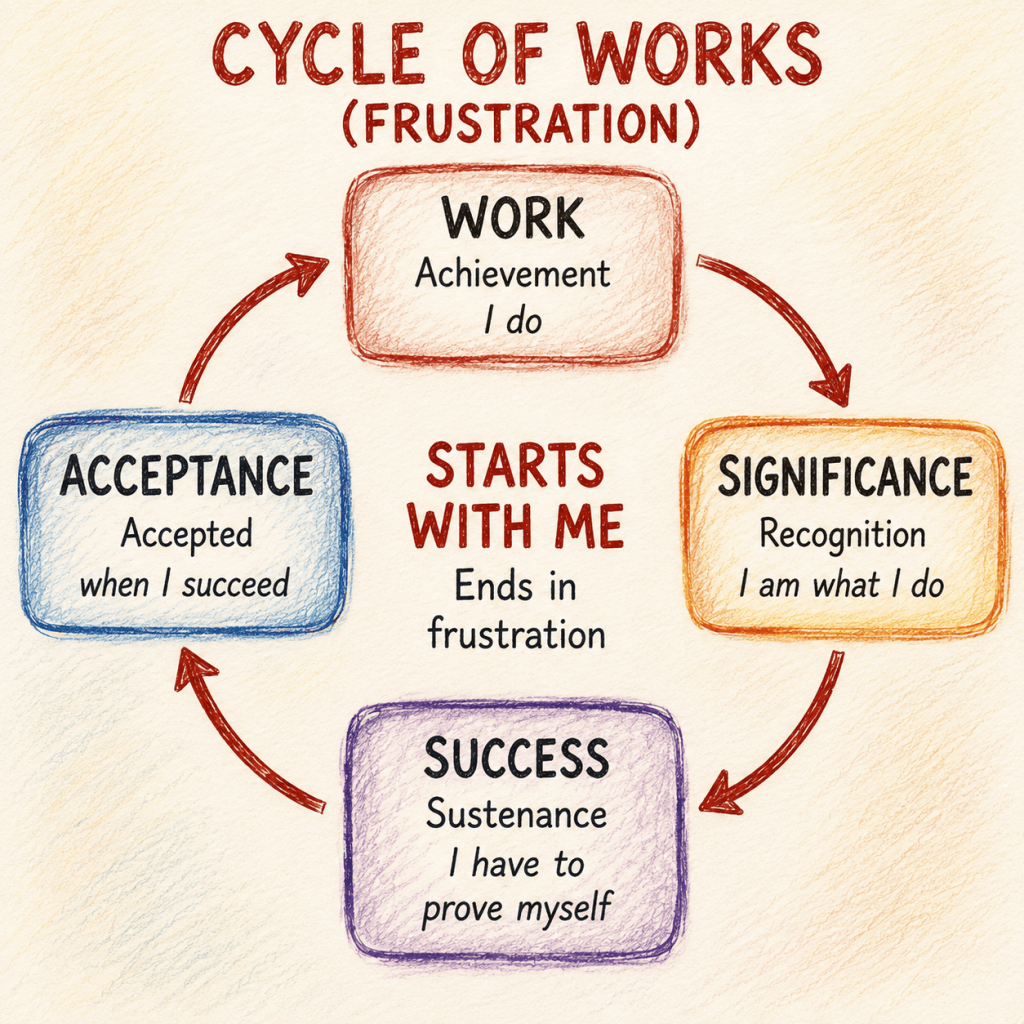
The Cycle of Works begins with achievement:
I accomplish something; therefore, what I do matters. Because what I do matters, I matter. Because I matter, I can feel accepted—by myself, by others, perhaps even by God. That acceptance gives me enough strength to work harder and achieve again.
The difficulty is obvious: eventually something goes wrong. We fail, mess up, find our limitations, let someone down, have to set a boundary. Cloud and Townsend say the problem with perfection is that it becomes a demand rather than a goal. Even for the non-perfectionist, we all find our God-given and very real limitations. This cycle often prevents us from accepting criticism or critique, which is why defensiveness is experienced – the cycle of works is a fragile identity.
The world changes, and often organizations, too. In response to change, our bodies become exhausted. Funding disappears. A colleague disappoints us. Leadership changes. We disappoint a spouse. A government refuses a visa. A project ends. Children need more of our attention. We overreact and yell at our kids. We become ill. Someone else receives the recognition. Technology makes part of our role obsolete. We retire. Sometimes we simply discover that we cannot keep going. And our identity can crack and crumble.
When achievement is the foundation of the cycle, a disruption to achievement threatens everything that follows. This is why even ministry can become a cycle of frustration. The work may genuinely be for God, while our identity has quietly become dependent on its results. We have begun to idolize work and productivity – we write about them in our newsletters, tie project funding to them, or base missions and visions on them. Sometimes this creates tension as organizations push for success as they define it and are built to get the results they are getting.
The problem is not that we are working. We are simply starting in the wrong place.
In the message, Eugene Peterson translates Matthew 11:28-30 this way. “Are you tired? Worn out? Burned out on religion? Come to me. Get away with me, and you’ll recover your life. I’ll show you how to take a real rest. Walk with me and work with me—watch how I do it. Learn the unforced rhythms of grace. I won’t lay anything heavy or ill-fitting on you. Keep company with me, and you’ll learn to live freely and lightly.”
This sounds more like the Westminster Catechism: The chief end of man is to glorify God and to enjoy him forever. Jesus’ invitation here does not sound like an invitation to a cycle of frustration.
The Cycle of Grace
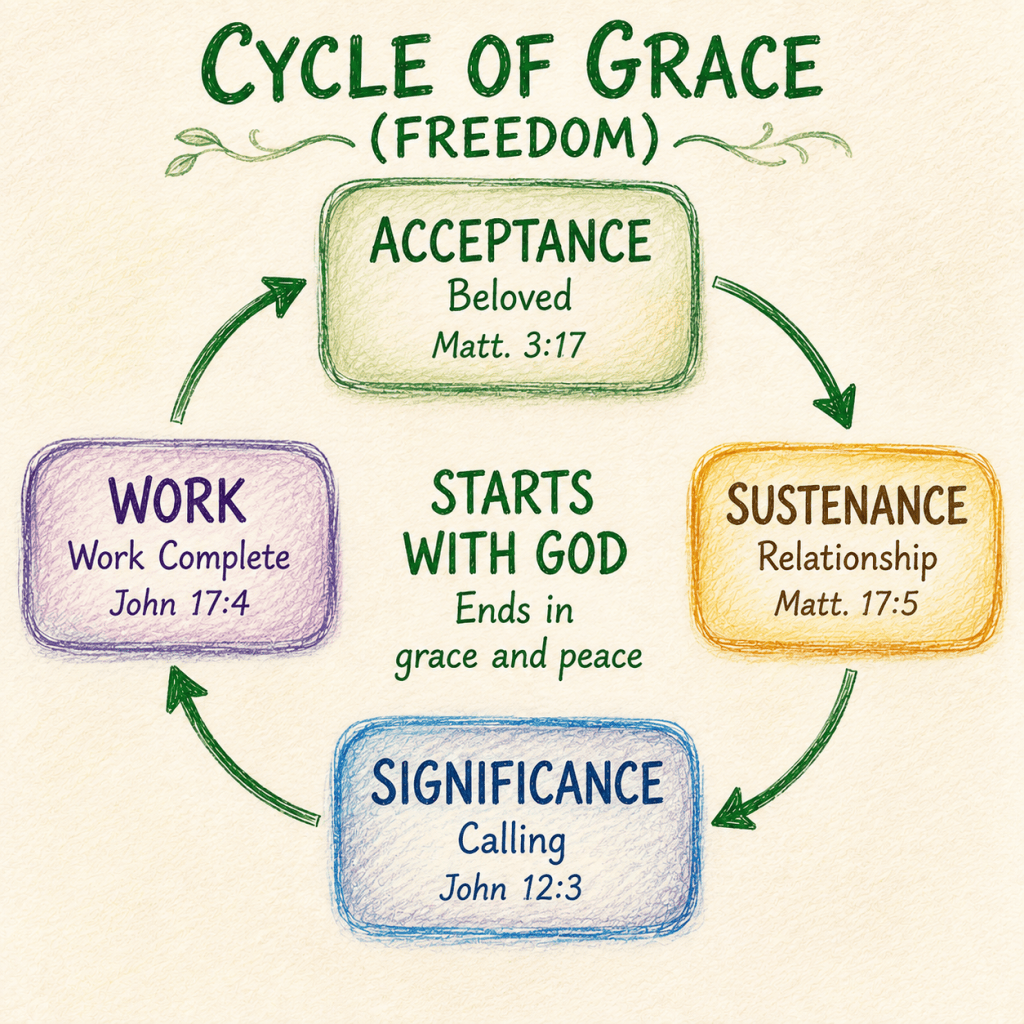
The gospel invites us to reverse the cycle. Instead of working toward acceptance, we begin with acceptance. Before Jesus began his public ministry, before the healings, teaching, miracles, disciples, cross, and resurrection, the Father declared:
“This is my Son, whom I love; with him I am well pleased.”
—Matthew 3:17
The declaration came before the ministry. Jesus wasn’t working for His Father’s approval.
That order matters. Jesus’ ministry flowed out of his relationship with the Father; it did not create that relationship. The same pattern of grace shapes the Christian life. We do not work our way toward God’s love. Our life and work flow from the love and grace we have already received in Christ. This is why success or failure is not a core tenet of our faith – His grace is sufficient; it is His power made perfect in our weakness (2 Corinthians 12:9).
Psalm 139 reminds us that we are known intimately by our Creator. John 3:16 reminds us that God’s movement toward humanity begins in love. Ephesians 2:8–10 holds grace and work together beautifully: we are saved by grace, not by works, and then, as God’s workmanship, we are invited into the good works he has prepared for us.
Grace does not eliminate work. Grace changes where the work begins.
Most importantly, when something goes in a way I didn’t expect, this ‘failure’ does not have the final word about who I am.
- A failed project may tell me something about the project or my gifting – It does not tell me whether I am loved.
- A lost visa changes where I can live – It does not change my identity in Christ.
- I can view my role living in cross-cultural ministry flexibly and respond well to organizational change or role shift.
- Burnout indicates my pace, expectations, environment, health, system, or work needs attention, not that I’ve disappointed God.
- Retirement ends a role or season – It does not end a calling to live in relationship with God and others.
In the Cycle of Grace, our identity is stable enough that our work can change… what we do, how we do it, where we do it, and who we do it with. Our calling becomes an open-handed invitation into a loving relationship with our heavenly Father – not a close-fisted must or a one-of-us-was-wrong dichotomy.
Living Out of Our Acceptance
This does not make us passive. In fact, it can free us to work more faithfully and more freely.
When achievement no longer has to prove our worth, we can pursue excellence without being destroyed by imperfection. We can admit mistakes. We can receive correction. We can try new things. We can celebrate another person’s success. We can rest. We can say no. We can change assignments. We can leave a role when necessary. We can endure seasons in which very little seems to be happening.
We can even fail—and learn.
The goal is not to care less about our work. The goal is to stop asking our work to answer questions that only relationship can answer.
Am I loved?
Do I belong?
Do I matter?
Who am I?
For Christians, those questions are ultimately answered not by our productivity but by our relationship with God through Christ. The invitation of Matthew Jesus says, “Walk with me and work with me—watch how I do it. Learn the unforced rhythms of grace.” This is the cycle of grace centered around walking with Him, not walking for Him. This is grace – the free gift of salvation from our loving Father.
That means significance can be found in an extraordinary range of work—from collecting garbage to leading an organization, from translating Scripture to caring for children, from managing a business to serving quietly behind the scenes. The value of the person does not rise and fall with the prestige, visibility, or measurable results of the task.
Because we are accepted, we are free to work.
And because our identity does not depend on the outcome, we are also free to rest, change, grieve, learn, fail, begin again—and sometimes let a work come to an end. It is what it means to live in freedom
James Covey, PhD, LPC-S
Questions for Journaling
How do I experience God’s love and acceptance?:
In what ways is my identity tied to my work?:
How am I at taking vacation, rest, and sabbath?:
How do I define my calling?
In what way is my calling open and flexible to God’s new invitations?
What do I need to relinquish or release?

